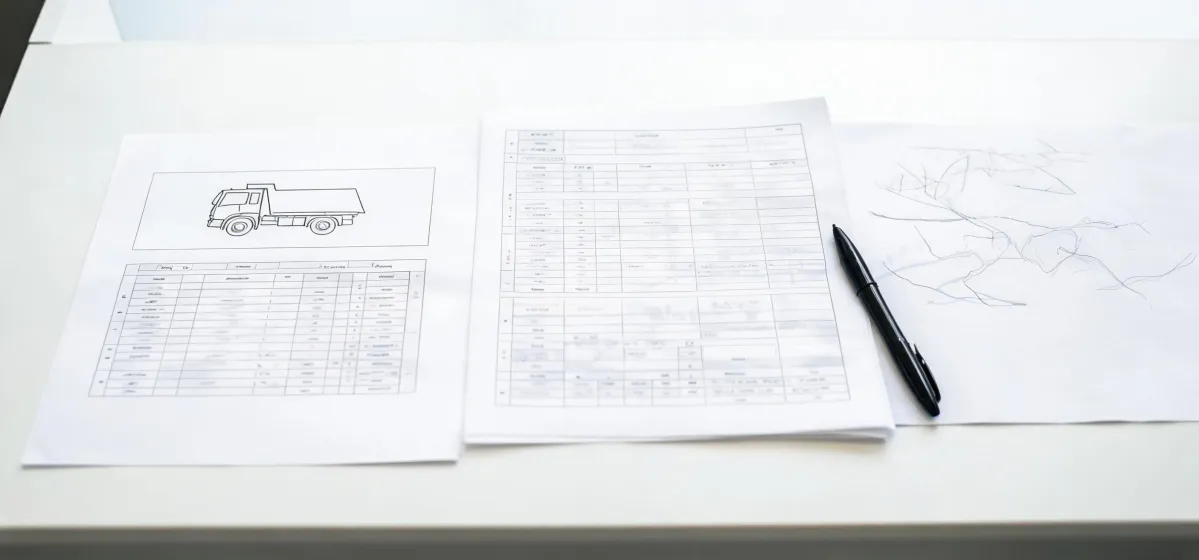
The body is up and holding. I'm standing at the tail of a Load King 16/18 ft dump body with a flashlight in one hand and the operator's manual folded open in the other, and the first thing I look at isn't the cylinder.
The check below applies to the covered Load King 16/18 ft body, and its wording comes out of the OEM manual language for this equipment, body and hoist, rather than out of what a yard has always done. The thing that decides whether you can work under it is simple to state: the bed is empty, and the raised body is physically resting on a sound body prop. Not holding on hydraulic pressure. Resting on steel, because a cylinder is a load-holding device, and holding something up is not the same thing as supporting it.
Why a Raised Body Is a Stored-Energy Problem
Gravity doesn't switch off when the pump does. A raised body is stored energy sitting above your head, and the only question that matters is what physical object sits between it and the ground. The cylinder is on one side of that question. A prop is on the other.
The reason the manuals insist the body rest securely on the body prop is the difference in how the two things fail. A mechanical column gives warning and it fails slowly. A bent leg, a cracked weld, a pin walking out of its hole, those are things you can see. A hydraulic hold has no such stage. It works right up to the moment a hose, a seal or a valve lets go, and then the body is coming down in one motion with nothing to catch it. Which means "it is still holding" tells you nothing about the next ten minutes, and a body that hasn't drifted since lunch isn't evidence of anything except that it hasn't drifted yet.
The Load King body manual runs hard in both directions: never place an arm, hands or any other body part under the body while it is running, and never go under a raised body for any reason without the body resting securely on the body prop. A hoist manual for a different dump-body family puts the same rule in wider terms, that whenever the body is in an elevated or raised position for repairs, adjustments, service or any other reason, it must be securely blocked or propped so that it cannot fall. Not should be. Must be, and cannot fall is the standard being asked for.
Why the Body Must Be Empty Before the Prop
The body prop is specified for an empty body only, and that same hoist manual is blunt about the other half: under no circumstances should any repair, adjustment or service be attempted on a loaded body while it is in a raised position. Empty comes first because the prop was built for one job, holding up an empty bed, and if material is still sitting in there you are asking it to do a different job with a load it was never intended to take.
Confirming empty is visual, and it has to be done from a position where you can see the whole floor, not from the ground beside the cab. Load gone, nothing stacked in a corner, nothing stuck to the sides or hung up against the tailgate. Wet or frozen material that clings is the usual culprit, because it reads as an empty bed from the outside and it isn't one. If you can't see the full floor, you haven't confirmed empty. You've confirmed the part you could see.
How to Tell the Prop Is Carrying the Load
A prop being present isn't the same as a prop carrying load. The manual asks for the prop to be checked regularly and says not to use it if it's damaged, so that inspection has to happen before it takes weight, because a bent pin or a cracked weld turns a slow failure into an instant one. You want to find that out before the prop is loaded, not while it is holding a body in the air.
What you're confirming comes down to two visible facts. First, the prop is in place, straight, and in actual contact with the body, not close to it. Second, the prop itself is undamaged. Both have to be true at the same moment. Either one failing means the body isn't supported, whatever the cylinder happens to be doing. The cue that this step is finished is that weight has transferred to the prop. If the cylinder is still the thing holding the body up, you're not done, and you shouldn't be underneath it.
Where the Manual Stops You and Why
Some of this check belongs to a trained technician, and the hoist manual quoted above says so plainly: don't attempt your own repair unless you are specifically trained, and if there are signs of improper or lack of maintenance, damage to any part, or loose mounting, don't use the hoist.
The boundary exists for a mechanical reason. Looking at a prop and looking at a mounting are not the same job. An inspection from the ground can tell you that a part is damaged. It cannot certify that a damaged part is fit to carry a raised body, and no amount of time in the trade changes that second question. Which is why the wording for your own body and hoist is the wording that governs, instead of the version somebody remembers from a different truck, and why the requirements shift from product to product.
What the 360 Walk-Around Is Actually Looking For
Walk the whole truck, all the way around, and look for two specific things: hydraulic leaks that showed up during operation, and critical components or fasteners that were damaged or loosened while the unit was working. The standing instruction to inspect the hoist and body before using the unit sits on top of that.
The plain version of why the circle matters: the leak that bites you is usually on the side of the truck you don't walk past. Half a lap isn't half a check, it's no check at all.
Those two items earn their own step because a leak and a loosened fastener are the routes by which a working circuit and a working body mounting turn into a failing one under load. Which means the walk-around catches exactly what the gauge in the cab cannot show you. Confirmation here is easy to fake and easy to be honest about: you went the full circle, all four sides, and you know it, instead of working the side you always work and calling the job done.
Findings That Mean Stop, Not Fix
Some findings end the job on that truck. Signs of improper or missing maintenance, damage to any part, a loose mounting, and the manual's answer is not to use the hoist. A damaged body prop gets the same treatment: it is not to be used. Neither of those is a judgement call about how bad it looks.
Suppose, for the sake of argument, a yard pulls a prop that no longer looks serviceable. The manual's answer is that it isn't usable, so the truck sits, and the decision in front of you is about the prop, replacing it or waiting on one, not about what else is standing around the shop that might hold the body up for ten minutes. That last part is where most of the real risk lives.
A stop call outranks a go call here because the failure mode has no second chance. A wrong go call is a body that stays up. A wrong stop call costs you a day of work. Those two aren't the same size, and treating them as if they were is the mistake that gets made.
Turning the Check Into a Yard Routine
Imagine a yard with several trucks and the same job waiting on each of them. The version that holds up queues every truck through one fixed order: empty the bed, get the body onto a sound prop, walk the full circle, stop on anything damaged. The only real variables are who signs off on each truck and how long it sits waiting for attention.
The order is the safety control, not the individual's confidence. A tech who has done it two hundred times runs the same four steps as someone in their first week, because the sequence doesn't depend on how sharp anybody feels at six in the morning. Past that, the numbers live in the manual for that specific body and hoist, inspection intervals and limits included, and this article deliberately doesn't supply them, because a figure lifted from the wrong manual is worse than no figure at all.
This isn't for the reader who plans to crack a line with the body up because it hasn't sagged yet, or who will drop a shop-made block in for a damaged prop. It's for the operator or fleet tech who works that order without skipping the slow parts, and parks the truck the moment something fails. The check costs a few minutes. The other outcome doesn't have a price you want to quote.
